AUTHOR’S NOTES
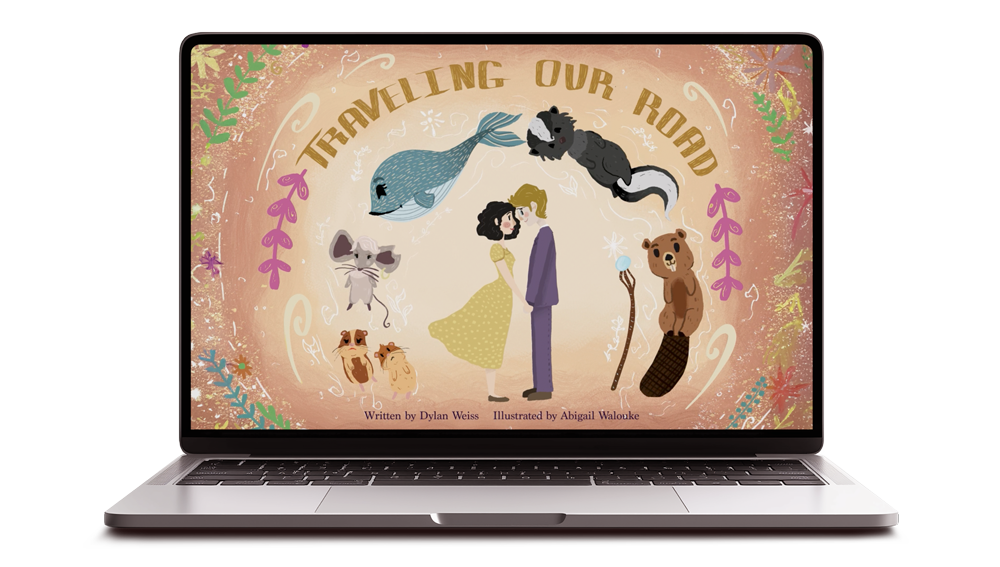
Traveling Our Road
Written by Dylan Weiss
Illustrated by Abigail Walouke
Published 2021
“Traveling Our Road” is a story inspired by my husband’s fifteen-year journey with early-onset Alzheimer’s disease and our family’s experiences as caregivers. Originally written to help children feel less afraid when visiting a loved one with dementia, it has also become a valuable conversation starter for adult caregivers and support groups.
Book Back | 1967
In 2021, Red Engine Press published “Traveling Our Road,” authored under my pen name, Dylan Weiss, in memory of my husband.
This hardcover picture book is suitable for readers of all ages and offers two practical benefits. Firstly, it helps ease anxiety for both children and adults preparing to visit a grandparent with dementia.
Secondly, it serves as a useful tool for support group leaders, helping them guide difficult discussions.
Page 9
Navigating the Challenge
“Traveling Our Road” is a memoir utilizing metaphor to depict how Dave and I navigated the challenges of early-onset Alzheimer’s disease. Despite my background in Speech-Language Pathology and specialization in geriatrics, our journey was fraught with various challenges. Although “Traveling Our Road” tells my story, it also offers others an opportunity to share theirs. For instance, Page 9 illustrates how Dave and I met. This is a good starting point for support group participants to share personal stories.
Page 14 & 15
Forget Me Not
On page 14, Dave hands me a bouquet of forget-me-nots, symbolizing love, memory, and my acceptance of him despite the disease. But on page 15, while still holding the now-wilted flowers, my expression changes. I realize our happy road is beginning to change. Support-group participants are encouraged to fill in the blank with the word that best describes how they felt during their own journey.
Pages 16 & 17
Rough Road
Page 16 shows us embarking on a rugged climb, while Page 17 mentions the challenges of this rough road. Here, support group members can share their challenges, discussing what was particularly difficult and scary for them, or what unexpected twists of fate they may have encountered.
Pages 18 & 19
Support Needed
“We were not alone. My secret friends were following us. I could see them — but DJ couldn’t.” On these pages, the narrator’s hidden support system is revealed. This is a good moment for support group participants to discuss who has been following their journey quietly, and what support they needed but didn’t ask for.
Page 20
Yell For Help
Page 20 introduces the important theme of asking for help. Many caregivers struggle to reach out for support, unsure where to turn or even what to ask for. The next several pages show how each animal character offers comfort and assistance in a different way — encouraging support-group participants to share their own needs and support one another.
Pages 28 & 29
Brain Scans
We loved traveling out west. On Page 28, we enter Utah’s Paria Canyon, where visitors must register because of dangerous flash floods. “Paria” may come from the Paiute word for “muddy water,” but it also echoes “pariah,” a reminder of the isolation many caregivers feel, an important topic for group discussion. On Page 29, Mousella Mouse joins me from a chapter in “Norton’s Tale,” where she navigates a brain-shaped island, a playful nod to a “mouse scan” instead of a CAT scan. Sharing these medical adventures and misadventures often helps support-group members connect and strengthen their bonds.
Pages 30 & 31
Diagnosis of Alzheimer’s Disease
On Page 30, The Isle of Ills symbolizes the moment of diagnosis and the beginning of an unfamiliar journey. On Page 31, Alzheimer’s disease is gently renamed ‘Old Hamster’s disease,’ offering children a less frightening and more approachable way to understand a difficult condition. This playful language can also help ease the anxiety adults often feel when preparing children to visit a loved one with dementia.
Pages 32 & 33
Plaques and Tangles
On Page 32, Amy and Lloyd Hamster symbolize the plaques & tangles associated with Alzheimer’s disease. Their tangled appearance & garbled speech reflect the communication difficulties & language loss that often occur as the disease progresses. As an SLP & as Dave’s wife, I watched his word-finding problems slowly develop into severe aphasia over many years.
Page 33 reflects the painful realization that Alzheimer’s had permanently changed our road together, and that returning to life as it once was was no longer possible.
Pages 34 & 35
Outer Smile Gone
On Page 34, the idea of an inner versus outer smile is introduced. As Dave’s disease progressed, depression made it difficult for me to smile, while he gradually lost facial expression because of the disease itself. In this moment, my cry for help becomes urgent and visible.
On Page 35, family and friends gather around us. These pages often spark discussion about how frightening visits can become — both for grandparents who long to stay connected to their grandchildren and for children who may feel uncertain or afraid. The support of family, friends, and support groups becomes essential.
Pages 36 & 37
What To Do?
Page 36 invites readers to consider how family and friends can nurture an inner smile when an outer one becomes difficult or impossible to see. This often opens meaningful support-group discussions about the small moments of connection that continue even as dementia progresses.
Page 37 introduces interactive activities, including a seek-and-find game, giving children a playful and less intimidating way to engage with the story and with loved ones experiencing dementia.
Pages 38 & 39
Visiting
The activities on Pages 38 and 39 offer ideas for children who may feel uncertain about visiting a loved one with dementia. A letter template encourages children to think about whom they plan to visit and what small acts of kindness or connection they might share.
These gestures are not measured by an outward smile, but by the possibility of creating an inner smile. Parents and grandparents can help children discover the special ‘magic’ their own unique gifts, creativity, and presence can bring.